ARTICLE
Why Are Enterprise AI Teams Talking About Ontology Again?
A practical introduction to business ontology, retrieval weighting, and agent collaboration in enterprise AI systems.
2026-09-10 · 0阅读 · 10 min
Why Are Enterprise AI Teams Talking About “Ontology” Again?
In 2026, people working on B2B AI, agents, and enterprise knowledge systems have started using one word more often: ontology.
The word can be confusing at first. It is not the body of a robot. In this context, it comes from philosophy and knowledge engineering. A simple way to understand it is:
An ontology is a description of the concepts, relationships, properties, and rules that make up a particular domain.
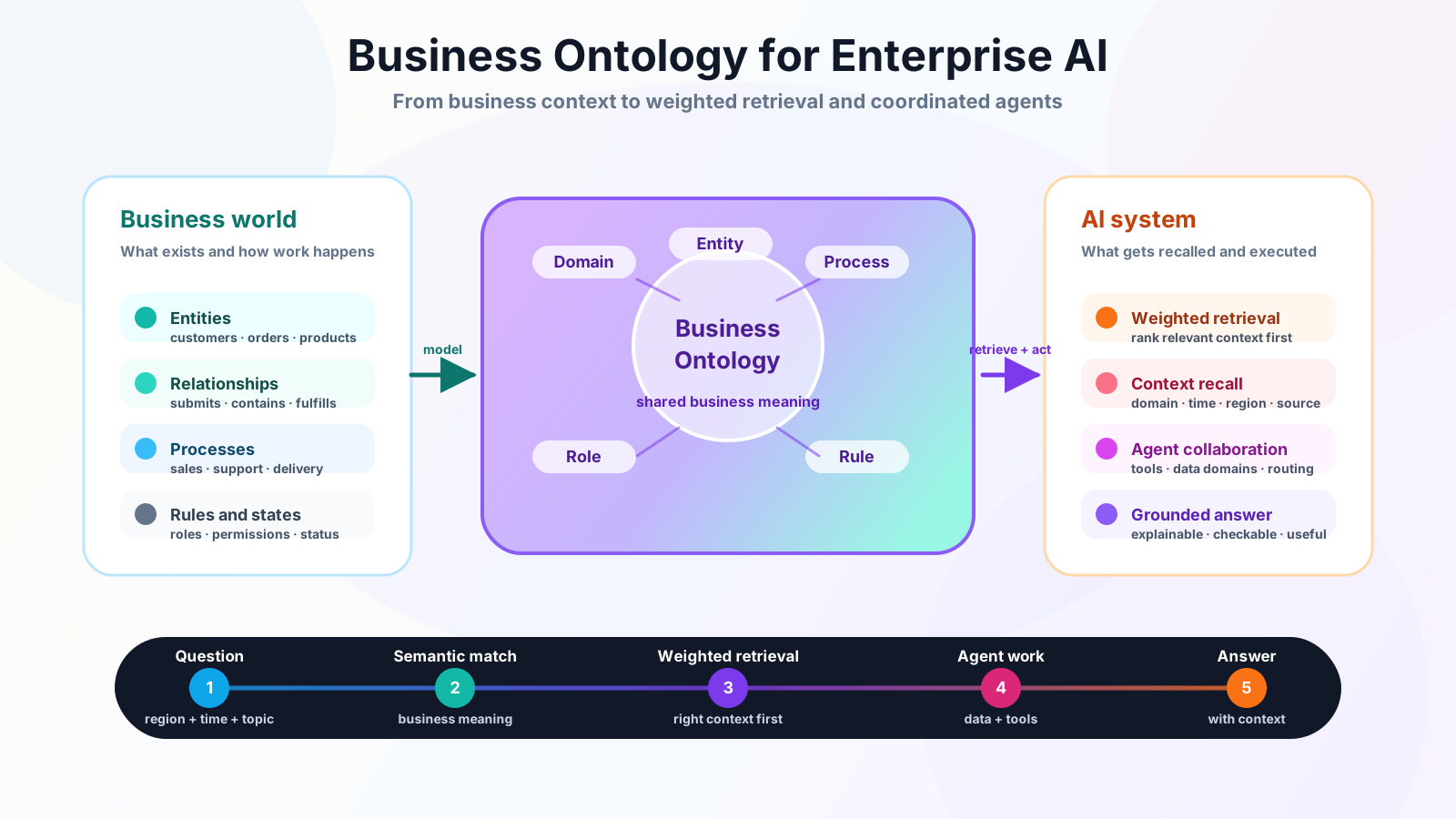
For enterprise AI, I think of it as a map of the business world. In a practical system, one of its first jobs is to help retrieval understand which pieces of context matter more for the current task.
It does not only tell an AI where documents are stored. It also helps describe:
- what people, departments, products, and business objects exist
- how those objects relate to one another
- how a business process unfolds
- who is responsible for which actions
- which rules and constraints should be respected
An ontology is not just an organization chart, and it is not simply a more sophisticated document index. It is a semantic layer that can help a retrieval system rank and connect business context before an agent starts acting.
Why has it become important again?
Ontology is not a new concept. It has been used for years in knowledge engineering, the semantic web, and knowledge graphs.
What has changed is the role of AI in the enterprise.
For a while, many enterprise AI projects focused on chat, search, and document question answering. If a model could find a relevant paragraph in a large collection of documents, that was often enough.
Agents have changed the situation.
An agent may now call tools, query databases, update files, trigger workflows, and coordinate with other agents. AI is moving from answering questions to taking action.
That makes fragmented information much less useful.
A model may be able to read a customer table, a sales report, and a process document. It may still fail to understand how customers, orders, products, stores, and fulfillment are related. It may not know which business domain a task belongs to, or where that task sits in the larger process.
The result is a familiar kind of failure: the AI has read a lot, but its work still does not match what the business actually needs.
This is similar to a person who watches many short videos and reads many posts about working methods. They may know how to write a weekly report, analyze data, or manage a project. They may have collected many useful templates.
But when they join a real company, they may still not know how the company makes money, which department owns which process, where the data comes from, or where the workflow usually gets stuck. They know many techniques, but they do not yet know when those techniques apply.
What they lack is not more information. They lack an understanding of the environment in which the work happens.
Agents can have the same problem.
An agent needs to understand its environment
When a person joins a company, we usually do not begin by showing them how to fill in one spreadsheet.
We first explain the company, its products, customers, organization, and current business situation. Then we give them accounts, project documents, handover materials, and working processes. Only after that do we expect them to handle tasks independently.
This is not just a formal onboarding ritual. Someone who does not understand the environment will have trouble deciding what a task means, how much effort it requires, and which other people or systems may be affected.
Agents need a similar foundation.
It is easy to give an agent a task description, a few documents, and several tools, then ask it to start working. The agent may understand what the task says on the surface. It may still not know:
- what the company actually cares about
- which business domain the task belongs to
- which roles and departments may be affected
- what a data field means in business terms
- which actions require human approval
- what happens after the current task is complete
An ontology helps make these relationships explicit. It gives the agent more than a pile of files. It gives the files a place in a business model, which can be used to increase the retrieval weight of more relevant context.
What does an ontology describe?
An ontology usually describes several kinds of things in a domain:
- Concepts or classes: customer, order, product, store, employee
- Individuals: a particular customer, order, or store
- Properties: order amount, customer tier, product inventory
- Relationships: a customer places an order; an order contains a product
- Events and activities: create an order, cancel an order, complete a delivery
- Rules and constraints: which role can perform an action, and which state can move to the next state
So an ontology is not simply a collection of documents with labels.
It asks:
What exists in this business world? What does each thing mean? How are these things connected? What can happen, and what should not happen?
For example, a sales ontology might include customers, sales representatives, opportunities, quotations, contracts, and orders. It might also describe the relationship between a sales representative and an opportunity, or the rule that an order can only be created after a contract has been confirmed.
Once those relationships are explicit, a retrieval system can use them as signals. A document about a regional order problem should receive more weight when the current question concerns that region, that order domain, and that workflow. The agent then has a better chance of understanding the task in the context of the whole business.
How is it different from a knowledge graph or an ER diagram?
These concepts are related, but they answer different questions.
A knowledge graph organizes entities and their relationships. It might represent a small part of a business like this:
Customer A → placed → Order 1001
Order 1001 → contains → Product B
Product B → fulfilled by → Store C
An ontology helps define what “customer,” “order,” “contains,” and “fulfilled by” mean, and which kinds of relationships are valid. Those definitions can become retrieval signals, so the system can rank documents and records by business relevance instead of relying only on keyword similarity.
An ER diagram is mainly used for database design. It asks:
Which tables and fields do we need, and how should the data be stored?
An ontology asks:
Which concepts exist in this domain, what do they mean, how are they related, and which rules constrain them?
In simple terms:
An ER model is mainly concerned with how data is stored. An ontology is mainly concerned with what the data means in the business world.
That does not mean an ontology is an upgraded ER diagram. They serve different purposes and often work together:
- databases store data
- ontologies define concepts and relationships
- knowledge graphs connect entities
- workflow engines move processes forward
- agent orchestration layers call tools and assign tasks
Keeping these layers separate makes the system easier to design and explain.
Ontology is not the same as a workflow
This distinction is easy to lose when we talk about enterprise AI.
In a sales visit process:
- customer, sales representative, opportunity, and store are business concepts
- preparation, visit, conversation, quotation, and follow-up are process activities
- customer ID, visit time, quotation amount, and follow-up status are data fields
- deciding which agent checks the CRM and which agent writes the summary is orchestration
These parts are connected, but they are not the same thing.
An ontology can describe the concepts, relationships, roles, and constraints that give the process meaning. It does not automatically become a workflow engine or a task scheduler.
A more precise way to put it is:
An ontology provides shared business semantics for retrieval, data, processes, and agents.
It helps different parts of the system understand that they are describing the same business world.
A practical example: a sales analytics agent
Suppose a manager asks:
How did sales perform in South China this week?
Without a clear business model, an agent might search for “South China sales,” find a few reports, and produce a polished summary.
But the question contains several concepts that need to be clarified:
- Which cities, stores, or business units count as South China?
- What exact date range does “this week” mean?
- Does “sales performance” mean revenue only?
- Should we include orders, average order value, target attainment, returns, and cancellations?
- Does fulfillment delay affect the conclusion?
With a business ontology, the main agent can identify these concepts before deciding what data and tools it needs.
The work might be divided like this:
User question
  ↓
Identify the meaning: region + time + sales topic
  ↓
Define the metrics: revenue, orders, average order value, returns
  ↓
Call the relevant domain agents
  ├─ Order agent
  ├─ Product agent
  ├─ Store agent
  ├─ Fulfillment agent
  └─ Supply chain agent
  ↓
Combine results, check definitions, explain anomalies
  ↓
Return an answer with its business context
The ontology does not perform the query itself. It does not replace the domain agents.
It provides a shared map. The retrieval layer can use that map to decide which context deserves more weight. The main agent can then decide where to look, which agents should collaborate, and whether their results can be compared.
If revenue increased while return rates and fulfillment delays also increased, the system can continue investigating instead of reporting the growth number as an unqualified success.
That is where the ontology becomes useful. It helps the system retrieve the right local evidence and connect it to the larger business process.
How do you build an ontology?
The first step is not opening a modeling tool and drawing boxes.
The first step is understanding the real business:
- where the process starts
- which steps it contains
- who participates
- how data moves
- how money moves
- what result the process is supposed to produce
Then we can define:
- the core concepts
- the important properties of each concept
- the relationships between concepts
- the activities that change an object's state
- the inputs and outputs of each task
- the roles responsible for each task
- the permissions and rules that constrain the process
It also helps to begin with concrete questions:
What do we want the AI to answer?
Which tasks should it assist with?
Which mistakes would be expensive?
Which business terms are interpreted differently by different departments?
These questions keep the model within a useful scope.
A company does not need to model the whole organization on day one. It may be better to start with one valuable domain, such as sales analysis, customer support, or supply chain coordination.
After the model is built, test it with real questions and real tasks. Can the agent identify the right concepts? Can it find the right data? Can it follow the business rules? Can a person understand why it reached the result?
An ontology also needs maintenance. Organizations change. Products change. Teams change. Metric definitions change. A model that was correct six months ago may quietly become misleading.
Versioning, ownership, evaluation, and review are part of the work.
When is an ontology worth building?
An ontology is not the answer to every AI project.
If the goal is to polish emails, summarize meetings, or draft ordinary marketing copy, a complete business ontology may be unnecessary.
It becomes more valuable when:
- one question requires data from several systems
- different departments use different definitions for the same metric
- agents need to call several tools or domain services
- the result needs explanation, tracing, or validation
- an error could affect revenue, compliance, or customer relationships
The evaluation should not stop at whether the model sounds fluent.
We should ask whether the system:
- completes more tasks successfully
- reduces rework and errors
- keeps business definitions consistent
- helps agents coordinate
- makes results easier for people to inspect
- justifies the cost of building and maintaining the model
Closing thought
An ontology is not just a fashionable label for adding another layer to an enterprise AI stack.
It addresses a simple question:
When AI starts doing real work inside a company, does it understand the business world in which that work takes place?
The model provides reasoning. The knowledge base provides information. The retrieval layer decides which information deserves attention first. Tools provide the ability to act. Workflow engines move tasks forward.
An ontology helps connect these pieces through shared business meaning. Its most practical first step may be simple: use business concepts, relationships, and process context to increase retrieval weights, so the agent sees the right information before it starts reasoning.
It may not be necessary for every company, and it does not need to be complete from the beginning. But as agents move from answering questions to executing tasks, and from working alone to collaborating with other agents, companies will eventually need to decide:
Which business objects, relationships, processes, and rules do we want AI to understand?
An ontology may be the map that makes that understanding possible.